September 30, 2026
The Future They Saw Coming: 30 Years of Evolving and Emerging Trends in Continuing Professional Development
By Raja V Akunuru, MBA, CHCP
Key Takeaways
- The article describes evolving and emerging trends from past Almanac archives since 1996.
- CPD’s core priorities, such as connecting education to practice and expanding the role of CPD professionals and providers, have remained consistent over the last 30 years.
- Continuing professional development is not new and continues to encompass a knowledge for all healthcare professionals.
Key Audiences
All CPD professionals.
If someone asked you to describe the future of continuing professional development (CPD), what would come to mind?
You might envision integrating education into practice, personalized learning, innovative tools to drive behavior change, broader collaboration and expanding the profession of CPD to serve more as facilitators of improvement than simply planners of education activities.
What may be surprising is that many of these concepts were discussed 30 years ago!
As the Alliance celebrates its 50th anniversary, revisiting these articles three decades later reveals a striking lesson from the Almanac archive:
Healthcare CPD has changed enormously, yet many of its most important ambitions have remained consistent.
Trend No. 1: Integrating Education and Clinical Practice
One of the clearest threads across the archive is the increasing connection between education and what happens in clinical practice.
In 1996, Alliance leaders called for stronger links between continuing medical education (CME), health outcomes and continuous quality improvement. Later that year, educational programming distinguished learning outcomes from patient health outcomes and emphasized the transfer of learning into the workplace1,2.
By 2007, the Almanac authors described CME as a strategic asset for improving physician competence and the quality and safety of healthcare. Educational strategies increasingly emphasized practice gaps, outcomes measurement, quality improvement and collaboration3.
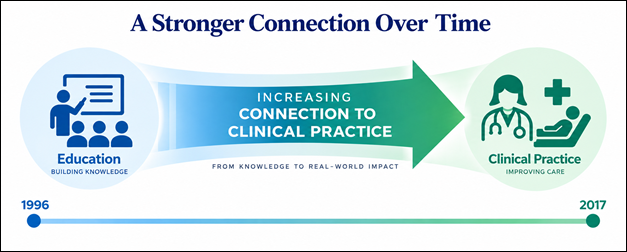
Then, in 2008, Dr. Murray Kopelow looked ahead to a learner-centered, practice-based model in which learning needs would arise directly from practice and success would be judged through changes in competence, performance and, ultimately, patient health. He also envisioned individual learning plans supporting that journey4.
By 2017, educational models looked quite similar to that vision: Learner and patient data, clinical quality measures, benchmarking, peer learning, quality improvement and personalized action plans5.
The goal was visible early. What changed was the field's ability and growing expectation to operationalize, measure and demonstrate it.
Trend No. 2: Expanding the Learning Ecosystem of Learning
A second pattern is the expansion of whom CPD is designed around.
Much of the early CME was centered on the individual physician. Yet even in 1996, Almanac contributors were asking whether educational planning should include patients, families, communities and other stakeholders6.
Over time, that circle widened. The Alliance itself broadened from CME toward continuing education across health professions. Interprofessional education became increasingly important.
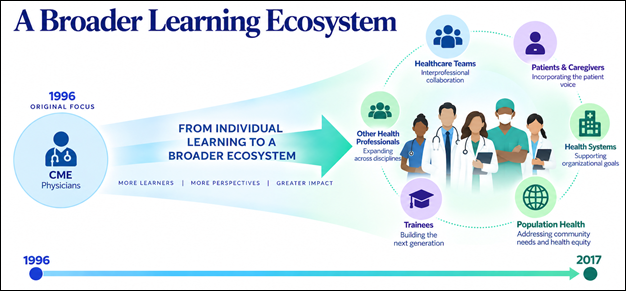
Educational initiatives began considering teams, systems, patient perspectives and population health.
This expansion reflects something deeper than a change in the audience. It reflects a growing understanding of how change occurs in healthcare. Clinicians practice within teams. Teams function within organizations and systems. Patients bring knowledge and perspectives that can influence both education and care.
CPD, therefore, moved closer not only to practice, but also to the ecosystem in which practice occurs.
Trend No. 3: Evolution of the Role of CPD
The role of the CPD professional evolved alongside these expectations.
The 1996 idea of moving from “linear planner” to facilitator is especially interesting6.
As the field became more complex, educational planning increasingly required expertise in learning and behavior change, research, outcomes measurement, quality improvement, collaboration and regulation.
By the mid 2000s, Almanac discussions about professional competencies and credentialing reflected a field that had moved well beyond purely administrative work7. By 2007, authors were calling for greater professional competence in learner focused educational design and healthcare quality improvement3.
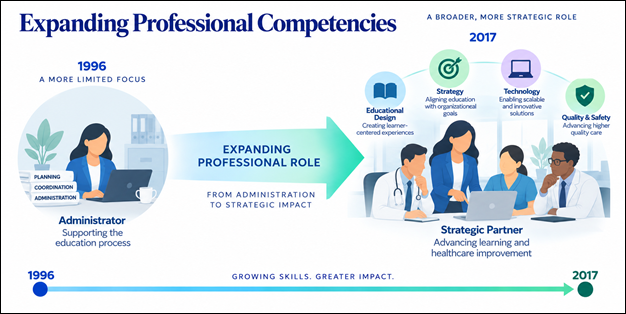
Later discussions added strategy, project management, finance, technology, change management, quality and safety to the professional skill set8.
These roles did not replace one another. They accumulated. Today's CPD professional may move among several of them within a single initiative.
That may be one of the most important changes documented by the archive: As the mission of CPD expanded, so did the strategic contribution expected from the people responsible for advancing it.
The Future They Saw Coming
Taken together, these trends make the archive's forward-looking ideas especially compelling.
In 1996, CPD leaders envisioned individualized learning, stronger understanding of behavior change, closer links to outcomes and quality improvement, broader stakeholder participation and an evolving professional role1.
In 2008, Dr. Kopelow envisioned learner centered, practice-based education connected to competence, performance and patient outcomes4.
By 2017, the archive was documenting educational models incorporating many of these elements into actual practice5.
What is striking is not simply that these predictions were directionally accurate. It is the consistency of the direction they described, closer to learners, practice, patients and measurable improvement.
Yesterday's emerging ideas gradually became today's foundations.
From the Historical Archive to Today's CPD
The historical collection reviewed for this article ends in 2017, but more recent Almanac articles suggest that many of these trajectories have continued.
Patient participation offers a particularly compelling example. The idea of involving patients and communities appeared in the archive as early as 1996. By 2022, the Almanac was examining patients as members of CE planning teams and evaluating the educational impact of their participation. Patients First: Educational Impact of Including Patients in CE Planning
Outcomes continued to evolve as well. Recent Almanac retrospectives describe greater emphasis on meaningful evidence of impact, standardization of outcomes terminology and better understanding of changes in practice and patient care. Advancing Continuing Medical Education: Reflecting on the Past and Charting a Path Forward
And the COVID-19 pandemic accelerated experimentation with virtual and scalable education. Yet even as delivery changed rapidly, the underlying educational questions remained familiar: How do we create meaningful learning? How do we support application to practice? How do we demonstrate impact?
In many ways, the years after 2017 reinforce the story found in the historical archives.
What Today's Emerging Trends May Become
That history provides a useful perspective on the next era of CPD.
Artificial intelligence (AI) is perhaps the clearest current example. Alliance survey findings show rapid adoption among CME/CPD professionals, with applications extending across needs assessment, educational development, outcomes, operations and strategy. How CME/CPD Professionals Are Implementing AI
But the archive suggests a more interesting question than simply whether CPD professionals should adopt AI:
Which longstanding ambitions might new capabilities help us advance more effectively?
Individualized learning is not a new goal. Neither are better needs assessment, stronger connections between education and practice, improved outcomes measurement or a more strategic role for CPD professionals.
AI, automation and connected data may allow some of these ambitions to be pursued with greater personalization, speed and scale.
The historical record also offers a useful principle. In 2014, as massive open online courses (MOOCs) generated considerable excitement, the Almanac emphasized the importance of educational substance and evidence when evaluating new education formats8.
The technology is different. The principle remains relevant.
The opportunity is not simply to adopt new tools. It is to use new capabilities intentionally to advance the mission CPD has been refining for decades.
Looking Back to See Forward
The Almanac archive tells a story of extraordinary evolution: Education moving closer to clinical practice and healthcare improvement; the learning community expanding toward teams, patients and populations; and CPD professionals becoming increasingly strategic partners in that work.
But beneath that evolution is a remarkable continuity.
Thirty years ago, CPD professionals were already discussing individualized learning, behavior change, stakeholder participation, outcomes, quality improvement and the evolving role of the education professional.
Each generation did not start over. It built on the ambitions of the generation before it and added new knowledge, evidence and capabilities.
That may be the most encouraging lesson of looking backward during the Alliance's 50th anniversary:
Many of today's established CPD practices were once predictions, experiments or emerging ideas. The concepts we are exploring today may similarly become the foundations upon which the next generation of CPD professionals build.
And perhaps that is the archive's most useful lesson about the future:
The tools may be difficult to predict. The direction of evolving and emerging trends and their progress is often much clearer.
Disclosure: The author used generative AI (ChatGPT 5.6 Sol) to support review of historical articles, brainstorming, drafting and image generation in developing this article.
References
- Board Addresses the Vision and Strategy of the Alliance, James Leist, Ed. D. President, Alliance for CME, Almanac, Volume No, 1, January 1996
- 1997 Annual Meeting Preview, By Bruce J. Bellande, Ph.D., Program Chairman, Southern Medical Association, Almanac, Volume No, 18, August 1996.
- Linking the Quality of Care Movement to CME, Jan Schulz, RN, MSN, Director of Educational Outcomes and Accreditation Services, Postgraduate Institute for Medicine, Michael R. Lemon, MBA, President, Postgraduate Institute for Medicine, Almanac, Volume No, 29, No. 3, March 2007.
- ACCME Chief Executive Murray Kopelow, MD, Responds to Questions from Almanac Editors, Almanac, Volume No, 30, January 2008.
- 2017 Innovative Format Award Winner, PerformanceNavigator®: A Novel Format to Improve Quality and Clinician Performance, By Gary C. Bird, Ph.D., and Amy Mullins, MD, CPE, FAAFP, American Academy of Family Physicians, Almanac, Volume No, 39, Number 04, April 2017.
- CME Programming: Making Sense Out of Chaos, Viviene Williams, Ph.D.,Ed.D., Samaritan Health System, Almanac, Volume No, 18, Number 5, May 1996.
- Evolution of CME Profession in the 1990s: The Paradigm Shifted, Joseph S. Green, PhD, President, Professional Resource Network, Incorporated Associate Consulting Professor, Duke University School of Medicine, Almanac, Volume No, 28, Number 5, May 2006.
- The Alliance for Continuing Education in Health Professions, Almanac, Volume 36, Number 5, July/August 2014.
Interested in this article? Join the discussion on the Alliance Community.
Raja V Akunuru, MBA, CHCP, is a recognized expert in healthcare education technology that drives scalable solutions and digital transformation across healthcare, education, and insurance, and is known for uncovering value-creation opportunities in technology investments. He holds an MBA from the Wharton School, has been honored as Best LMS Demonstrator by Talented Learning and is a member of the Almanac Editorial Board. Outside work, he enjoys experimenting with tea and cartooning with his two daughters.